
Clay Scheduled and Actual Release
A projected or scheduled release date is a forecast based on the sentence and the credits then in the record. An actual release date marks an event that has already occurred. FDC uses the public label Current Release Date on a current inmate detail. Florida law calls the related gain-time calculation a tentative release date. Both terms describe a date that can move before the person leaves custody.
The exact label matters. FDC warns that Current Release Date is subject to gain-time awards, forfeiture, or review. A value of “TO BE SET” means the agency has not completed the review, so no date should be estimated. “Confinement Status” is also unsafe as a stand-alone answer. FDC treats it as an internal facility status. A record may say “Not in Confinement” while still listing a current facility and currently incarcerated status.
A Clay County pretrial detainee is different. Until the court sets and satisfies a release basis, there is no sentence-based date to calculate. Bond, recognizance, dismissal, a plea, or another court order may change custody. The Clay jail and Clerk records are the right path for that person, not an FDC projection.
Find a Clay Projected Release Date
Start by deciding whether the person is in the Clay County Jail or an FDC prison. The FDC current-population search covers state prisoners. It does not calculate the date for a jail-only Clay sentence. Search by the six-character DC number when possible. Otherwise use first and last name, keep aliases enabled where useful, and match the photograph, birth date, county, case number, and custody details.
- Identify the holding system from the Clay jail card, transfer record, court docket, or FDC record.
- For an FDC prisoner, open the matching current-population detail and record the Current Release Date and its warning.
- For a Clay jail sentence, obtain the judgment and jail-credit terms from the Clay Clerk, then ask CCSO for its sentence computation.
- Check for other cases, holds, detainers, or amended orders that may block release to the community.
- After the date passes, switch to FDC Inmate Release Information or request the CCSO release event and confirm an actual date out of custody.
The official current-population form shows the state search fields used before opening a detail record.
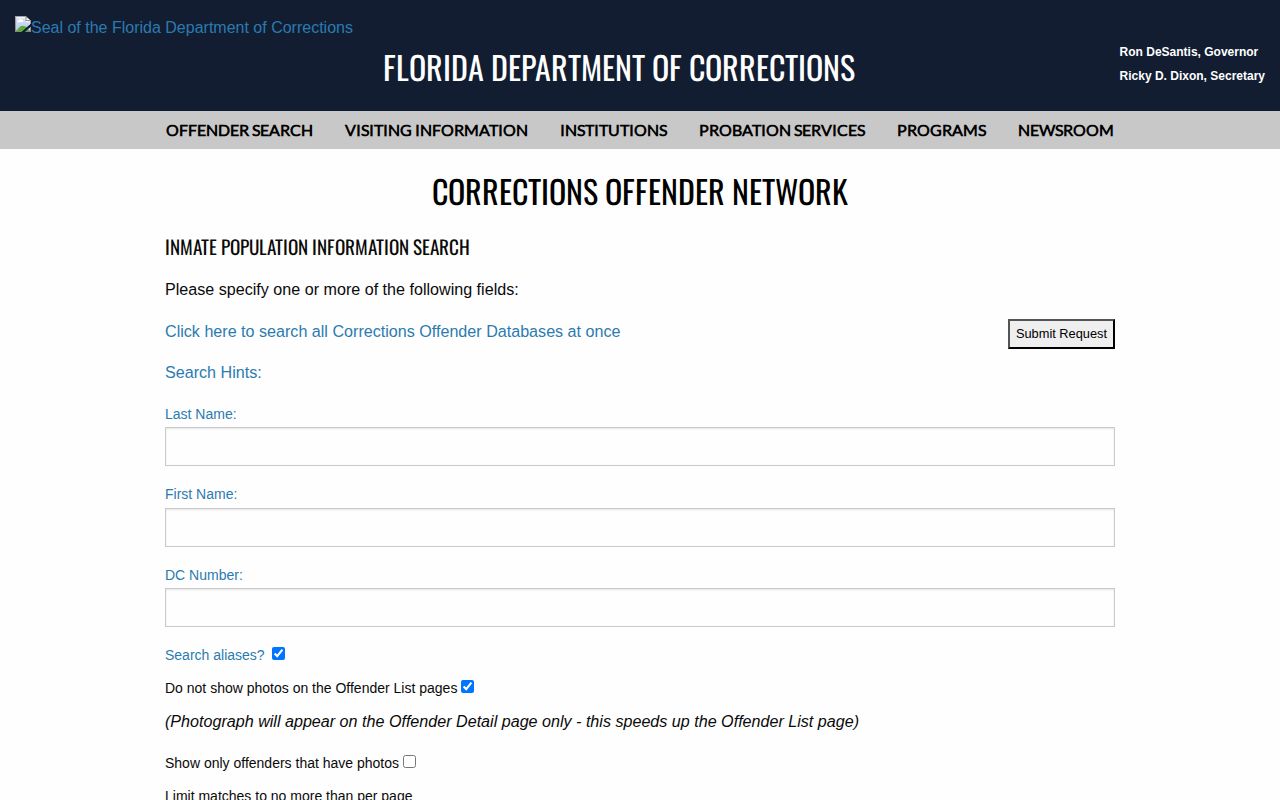
This search is best for an FDC prisoner who has not yet left state custody. For a named person already released, the Clay County released inmates search path explains how to reconcile jail, court, and state records.
Note: A Clay County arrest followed by transfer to FDC requires the state search, while a jail-only term stays with CCSO.
Florida Gain Time for Clay Releases
Florida Statutes section 944.275 governs FDC gain time. For offenses committed on or after October 1, 1995, the law authorizes up to ten days per month of incentive gain time for an eligible person. It also permits limited meritorious awards for an outstanding deed or service and a one-time award for eligible completion of certain educational or vocational work. These are possible awards under set rules, not a flat amount subtracted from every sentence.
The same statute creates the 85-percent floor for a person subject to the cited incentive-gain-time rule. Gain time cannot cause release before at least 85 percent of the imposed sentence is served. Court-awarded time spent physically incarcerated may count toward that floor. Florida's Criminal Punishment Code in section 921.002 also states that the sentence reflects actual time, reduced only by authorized gain time and not below the statutory floor for covered cases.
A 1,000-day example shows the limit without calculating any person's date. If the 85-percent rule applies, gain time cannot reduce qualifying service below 850 days. That simple example omits many facts that control a real case, including offense dates, ineligible offenses, sentence overlap, court credit, forfeitures, detainers, and later record review.
The official gain-time law defines the tentative release date and the limits on awards.
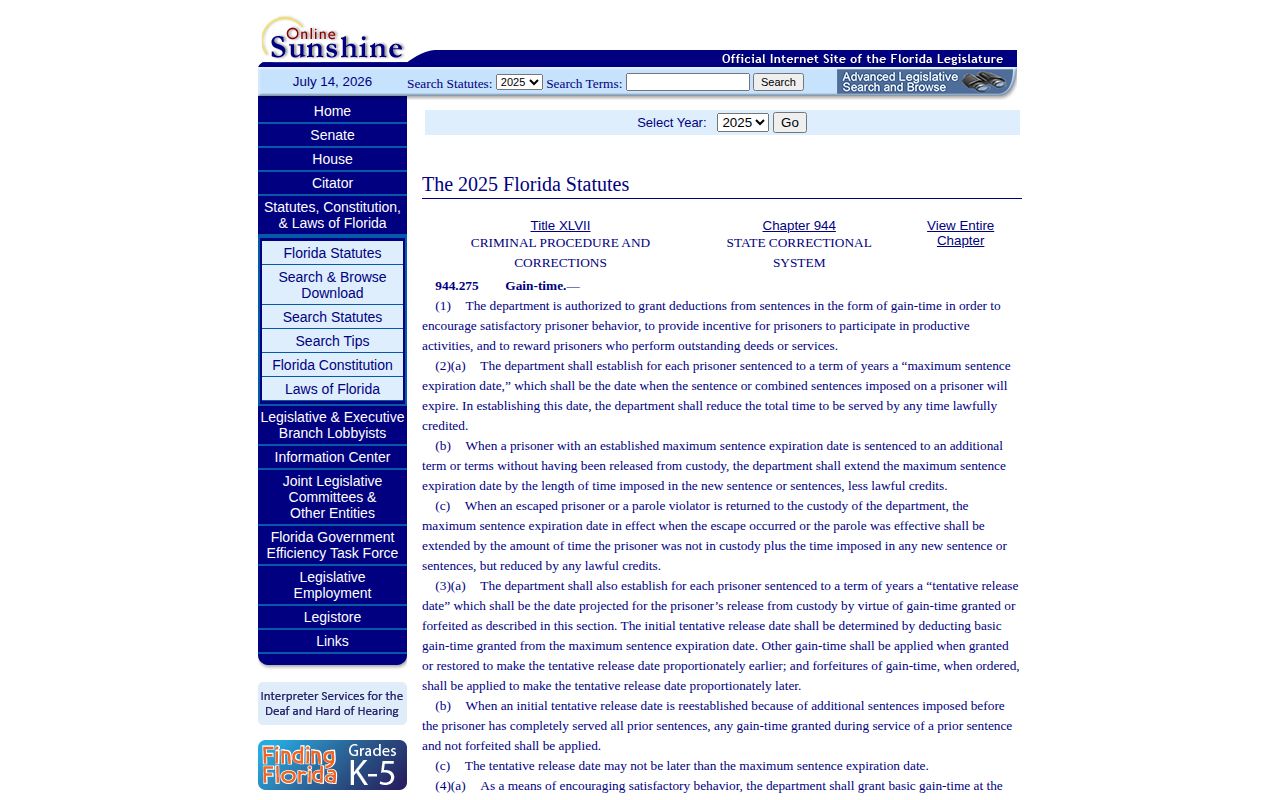
The statute explains why a public Current Release Date may change without becoming an error.
Clay Jail Release Date Computation
A Clay County jail-only sentence does not use the FDC formula. Florida Statutes section 951.21 supplies a separate county-prisoner good-conduct framework. Unless the county commission changes or discontinues it, the maximum tiers are up to five days per month in the first two years, ten per month in years three and four, and fifteen thereafter. A further meritorious allowance of up to five days per month may be recommended.
Those statutory ceilings do not prove Clay's current policy or an individual award. The older Clay jail handbook mentions that certain inmate workers may receive one to five days off per month. That language cannot be turned into a rule for every person. Current classification, work status, forfeiture, local action, and the court's jail credit must be verified.
The record path is split. The Clay Clerk judgment shows the sentence and court-awarded credit. CCSO holds the jail computation and local gain-time policy. FDC owns the state-prison computation. Requesting all three from one office can lead to a partial answer because each custodian controls a different piece.
Clay FDC Release Date Fields
An FDC current-inmate detail provides more than one date and status. Initial Receipt Date marks entry into the present state-custody sequence. Current Facility identifies the assigned institution. Current Custody describes the agency's custody level. Incarceration History can show earlier periods. Current Release Date is the forward-looking field that answers the planning question, subject to the warning on the record.
After release, the separate state release search adds fields needed to prove the event. Release Date is the reported release date. Date Out-Custody appears within incarceration history and should also be past. Stated Residence Upon Release may show the reported destination, while county and case data connect the state record back to Clay. None of those fields supplies a public release-reason label.
| FDC field | Proper use |
|---|---|
| Current Release Date | Plan around the agency's current forecast, while keeping the change warning. |
| Release Date | Check the reported release event in the release-information record. |
| Date Out-Custody | Confirm that the incarceration-history segment ended. |
| Current Facility | Identify the state institution responsible before release. |
| County and case number | Match the FDC sentence to the correct Clay court case. |
A screen capture is useful for noting what the public record showed on a given day, but the agency may later correct the data. When the date is disputed, ask FDC for the underlying calculation and release authorization rather than treating an older capture as final.
Why Clay Release Dates Change
A projected date can move for a lawful reason. The public field is a result of the agency's current calculation, not a guarantee. When a date changes, compare the new detail record with the court docket and ask for the calculation history instead of assuming the earlier date was an actual release order.
| Factor | Effect on the Clay release date | Record to check |
|---|---|---|
| Gain-time award or restoration | May move an eligible FDC tentative date earlier, subject to statutory limits. | FDC calculation and incarceration history |
| Disciplinary forfeiture | May move the FDC date later under section 944.275. | FDC gain-time and disciplinary record |
| Corrected sentence or jail credit | Can change the base calculation or credited time. | Clay court order and agency computation |
| Concurrent or consecutive terms | Changes how multiple sentences overlap or follow each other. | Judgments and sentence structure |
| Detainer or another-agency hold | May send the person to another custodian instead of the community. | Release authorization, hold, and receiving-agency record |
| Parole or Commission action | A final order may establish, defer, withdraw, or revoke a release path for an eligible case. | FCOR final order and FDC status |
A detainer is a request or notice from another authority concerning custody. It means leaving one facility may be a transfer. It should never be reported as community release without the receiving record.
Confirm Clay Actual Release Dates
For a completed state-prison release, use the FDC Inmate Release Information Search. A hit can include people already released and people only scheduled for release because FDC updates that database nightly. Open the detail and require both Release Date and Date Out-Custody to be in the past. If the release reason matters, request the underlying admission and release file. The public detail does not display a field expressly labeled release reason or discharge.
For a Clay jail event, ask CCSO for the physical release date and time, reason, holds, and receiving agency. Compare that response with the Clay criminal docket. A court order supplies the legal authority, but the jail record supplies the point when booking staff completed the exit. Notification can help with timing, but the Clay County VINELink check remains an alert and status channel rather than a certified release record.
When an FDC calculation is disputed, request the release-date calculation, release authorization, and incarceration history through FDC public records. The custodian is at 501 S. Calhoun Street, Tallahassee, FL 32399. Public-record assistance is available at (850) 717-9774. Include the name, DC number, Clay case number, exact record names, and date range.
Ask for an electronic copy and a cost estimate. A focused request can name the sentence computation sheet, gain-time history, forfeiture or restoration entries, release authorization, and each incarceration-history segment. If the issue began with a corrected Clay judgment, attach or identify that order. FDC Classification and Central Records handles suspected data errors at (850) 488-9859. Date and status questions may also be routed to the Bureau of Admission and Release at (850) 488-9167 or dc.release@fdc.myflorida.com.
For a county calculation, give CCSO the booking number, sentence dates, and Clay case number. Ask for the current jail computation, all credited days, the local gain-time policy applied, any forfeiture, and the planned release authority. A court clerk can provide the judgment but cannot certify the booking-room exit. Likewise, FDC cannot certify a jail-only Clay release that never entered state custody. Keeping the request with the right office avoids a date that looks official but belongs to the wrong system.
Note: A past scheduled date is not proof of release unless the agency record also documents the completed custody exit.