
Clay Court Release Record Role
The Clay County Clerk of Court and Comptroller maintains the criminal docket. It is an essential mapped record system because a court case can remain available after a short-lived jail card disappears. It is not a detention facility, does not hold people, and does not process a physical release. Its job is to preserve filings and orders in the legal case.
A judge may set bond, order recognizance, dispose of charges, impose a sentence, award jail credit, or place a person on probation. Those acts can authorize or explain release. CCSO booking staff must still receive and process the paperwork, check other-agency wants, and close the booking. A court timestamp and a Clay County Jail exit timestamp may therefore differ without either record being wrong.
Search Clay County Release Records
Begin at the Clay Clerk search page and choose the court-record route. Search by the defendant’s name, then narrow with the case number and arrest period. Similar names and repeat cases make the case number important. Compare the docket to the booking agency, charges, and court date shown in the sheriff catalog.
- Search the exact first and last name, including spelling variants when no case appears.
- Open each possible criminal case and compare the arrest date, charges, and booking reference.
- Read the bond, release, plea, disposition, judgment, sentence, and probation entries in date order.
- Save the case number and exact order date for a CCSO release-record request.
- Ask the jail for the physical exit time, release reason, holds, and receiving agency.
The direct court interface and its search fields are shown in the official Clay court search image below.
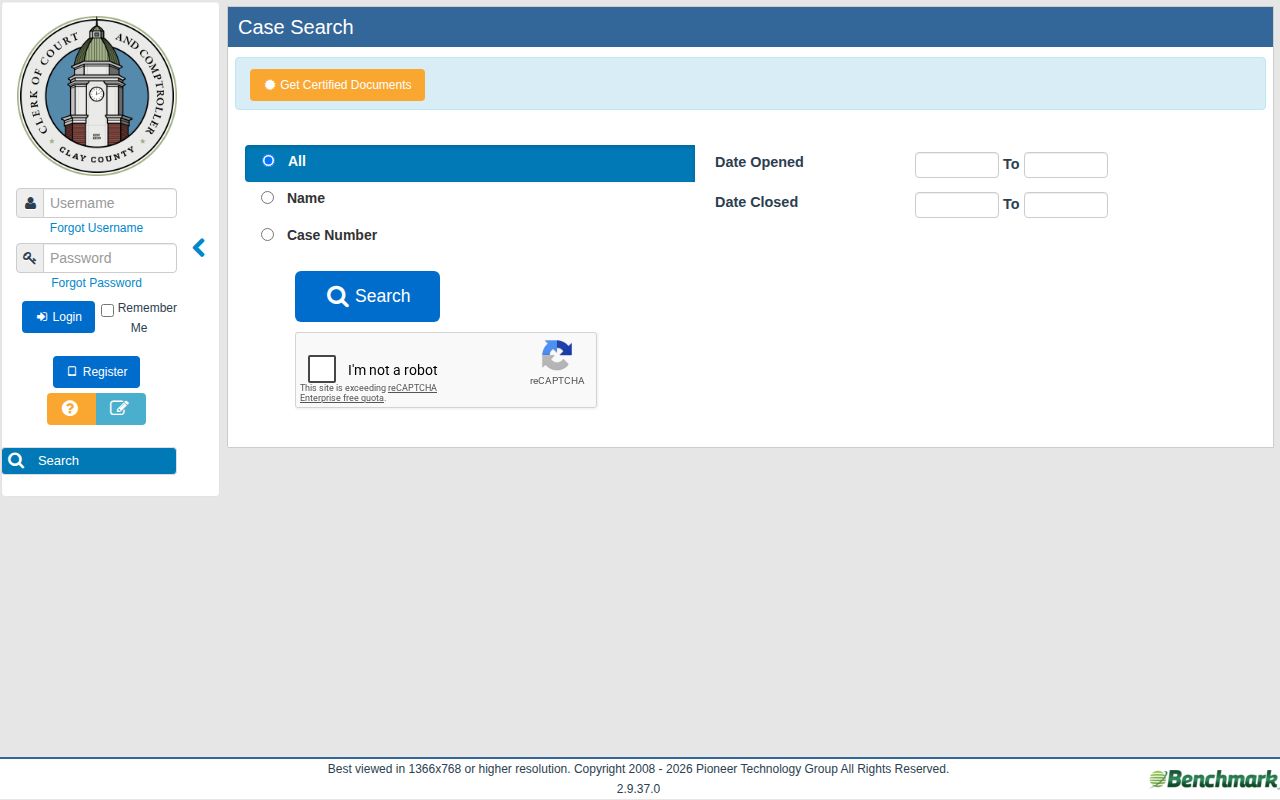
The fields help locate the legal case, but a search result alone does not certify the physical moment of release.
Clay County Release Order Fields
A useful Clay criminal case record connects identity, charges, legal authority, and later completion. Read the docket as a sequence rather than treating one entry as the whole story. A first-appearance order can set bond, a later filing can modify it, and a final disposition can resolve the charge months after release.
| Court field or entry | What it can establish |
|---|---|
| Case number and defendant identity | The legal case linked to the booking |
| Charge and arrest reference | Why the case entered court |
| Bond and conditions | The court-authorized path out while the case continues |
| Recognizance or release order | Authority to release without a surety bond |
| Disposition | Dismissal, nolle prosequi, plea, judgment, or another case result |
| Sentence and jail credit | The ordered term and credited custody days |
| Probation, violation, completion | Supervision that follows release and its later status |
“Nolle prosequi” means the prosecutor declined to continue that charge. It is a court disposition, not a timestamp from the jail. “Jail credit” means days already spent in custody count toward the sentence. It does not show when CCSO finished processing the exit.
Match Clay Release Exit Records
The strongest Clay County release confirmation pairs the court docket with the sheriff’s booking event. The Clerk may show that a judge ordered release on a certain day. CCSO can show when booking received the order, whether another hold appeared, and when the person left or transferred. Court paperwork may arrive at booking in batches rather than hearing order.
| Question | Court record answers | Jail record answers |
|---|---|---|
| Why could release occur? | Bond, order, disposition, sentence | Authorization received and release reason |
| When did it happen? | Order or filing date | Physical exit date and time |
| Did custody fully end? | May identify the legal outcome | Holds, detainers, and receiving agency |
| What followed? | Probation or later case events | Transfer destination at the exit |
The Clay County Jail release page details the booking event and CCSO request route. Use the same case number, booking number, identity, and date range in both requests so the records can be reconciled.
Note: Matching case and booking numbers prevents a same-name court case from being paired with the wrong custody event.
Clay Court Records Contact
The Clerk offers unofficial copies of many online records without charge. A formal request may carry fees. The Records Management Liaison Officer accepts mail and email, and the courthouse provides weekday access. Ask for the criminal docket, release-related orders, judgment, sentence, jail-credit entry, and probation or completion filings tied to the case number.
Clay County Clerk of Court and Comptroller825 N. Orange Avenue
Green Cove Springs, FL 32043
(904) 284-6302
Monday through Friday, 8:00 a.m. to 5:00 p.m.
publicrecords@clayclerk.com
A request to the Clerk will not produce CCSO’s booking-room event log. Likewise, the sheriff cannot substitute for a certified court disposition. Send each custodian a request limited to the part of the record it created. This approach also makes it easier to identify a missing filing or a timing difference.
Note: The courthouse and jail are nearby, but each office maintains a separate release-related part of the record.
Request Clay Release Court Copies
Use the exact case number whenever possible. State the defendant name, arrest period, and the entries sought. Request electronic copies and an estimate when a formal search may involve many pages. The Clerk can provide its own legal filings and disposition records. CCSO Public Records handles the jail booking and release event.
- First-appearance and probable-cause records
- Bond, recognizance, and release orders
- Plea, dismissal, nolle prosequi, or other disposition
- Judgment, sentence, and awarded jail credit
- Probation, modification, violation, and completion entries
For the physical release segment, ask CCSO for the authorization received time, release event, holds, transfer sheet, and destination. One broad request sent only to the Clerk cannot produce a jail record, an FDC state-prison record, a federal record, or an ICE record.
Clay Court Release Access Law
Florida Constitution article I, section 24 and Florida Statutes Chapter 119 establish broad access to government records, subject to specific exemptions. Section 119.07 governs inspection, copying, and authorized fees. A custodian may redact protected information while releasing the parts that remain public.
Juvenile records, sealed or expunged cases, medical facts, protected victim information, certain investigative material, security information, and protected personal data may be withheld or redacted. A partial Clay County court record can still identify the case, order date, and public disposition. Ask the Clerk to state the legal basis for a redaction when that basis is not clear.
Sealed Clay County Release Records
Sealing or expungement can restrict public access to a Clay criminal case. It does not change the historical fact that custody ended. A no-result response after lawful relief is not proof that no arrest or release occurred. Florida generally requires an FDLE Certificate of Eligibility before a person files the local petition, but the certificate itself does not grant relief.
The Clay Clerk provides local petition, affidavit, and proposed-order forms. Only a court order seals or expunges the case. Sections 943.0585 and 943.059 govern the main Florida processes. The Clerk routes seal and expunge questions at (904) 278-3650, while legal advice should come from a licensed attorney or recognized legal-aid provider.
Keep certified dispositions and the final order before access becomes restricted. Some agencies retain limited access under law, and an expunged record can still be reached in narrow circumstances by court order. Public search visibility and government retention are not the same issue.
Note: A sealed search result may disappear from public view even though the underlying custody event once occurred.
When Clay Court Release Leads to ICE
A Clay court order can authorize release from the county case while an immigration detainer changes what happens next. The Clerk docket may show the judge's action, but the CCSO transfer sheet and release event identify whether booking staff handed the person to ICE. A county case release followed by ICE custody is not a community release.
Historical federal records show immigration detainees at the Green Cove Springs jail in 2003. Current ICE facility sources reviewed for this project do not establish Clay County Jail as a current ICE detention site, so that old record cannot support a present-tense contract claim. When an actual Clay release sheet names ICE, use the ICE detainee locator for the next custody stage and retain the court order as the legal part of the record chain.
Missing Clay Release Court Results
A blank Clay Clerk search can reflect spelling, a different name, the wrong date range, a sealed record, protected information, or a search problem. Try aliases, middle initials, hyphenation, and the exact case number. Compare the arresting agency and booking period before searching a neighboring county.
If the court case appears but the jail card does not, request the older booking directly from CCSO. If the jail record says transfer to FDC, federal custody, or ICE, move to that custodian after preserving the Clay case and release event. The Clay County released inmate lookup maps those distinct systems without treating any single no-result screen as proof of freedom.
Clay Court Records System
The Clay criminal court record belongs in the county release map because it preserves legal authority and case outcome. Still, it is not a jail, prison, supervision office, or custody locator. Its value is strongest when the public inmate catalog no longer shows the booking or when the release reason must be checked against the judge’s order.
Use the Clerk for orders, disposition, sentence, jail credit, and probation filings. Use Clay County Jail for the booking-room event and transfer destination. Use FDC, BOP, or ICE only when the Clay release record names that next system. This division keeps the legal record and physical custody record accurate.