
Florida Corrections Releases After Clay
A Clay County Jail transfer to FDC ends the county booking but does not end custody. FDC assigns sentenced prisoners across its statewide system, so proximity to Clay should never be assumed. The CCSO transfer sheet or release event should identify FDC or the receiving institution. Once state custody begins, the FDC offender record becomes the main public route for location, prison dates, release, and supervision.
State-prison release also has more than one possible next step. A person may reach the community with no FDC supervision, begin probation, parole, conditional release, or another form of community supervision, or move under another authority's hold. Florida Department of Corrections supervises probationers and parolees, while the Florida Commission on Offender Review makes parole decisions for eligible populations. Prison release and full sentence discharge are therefore separate events.
Confirm an FDC Release Record
Begin at the FDC Corrections Offender Network. It separates current inmates, inmate releases, supervised people, escape records, and absconders. For someone believed to be out of prison, choose the Inmate Release Information Search. That database contains both completed and scheduled releases and updates nightly, so opening the full detail is essential.
- Search by the six-character DC number when known. Otherwise enter first and last name and keep aliases enabled where useful.
- Match the photograph, birth date, race, sex, aliases, Clay County case number, and sentence history.
- Open the detail and confirm that both Release Date and Date Out-Custody are in the past.
- Read Stated Residence Upon Release and supervision data in context. They do not replace the completed custody dates.
- If the reason or calculation matters, request the admission and release file from FDC and compare the Clay court judgment.
The official search menu shows the six distinct FDC databases available for this work.
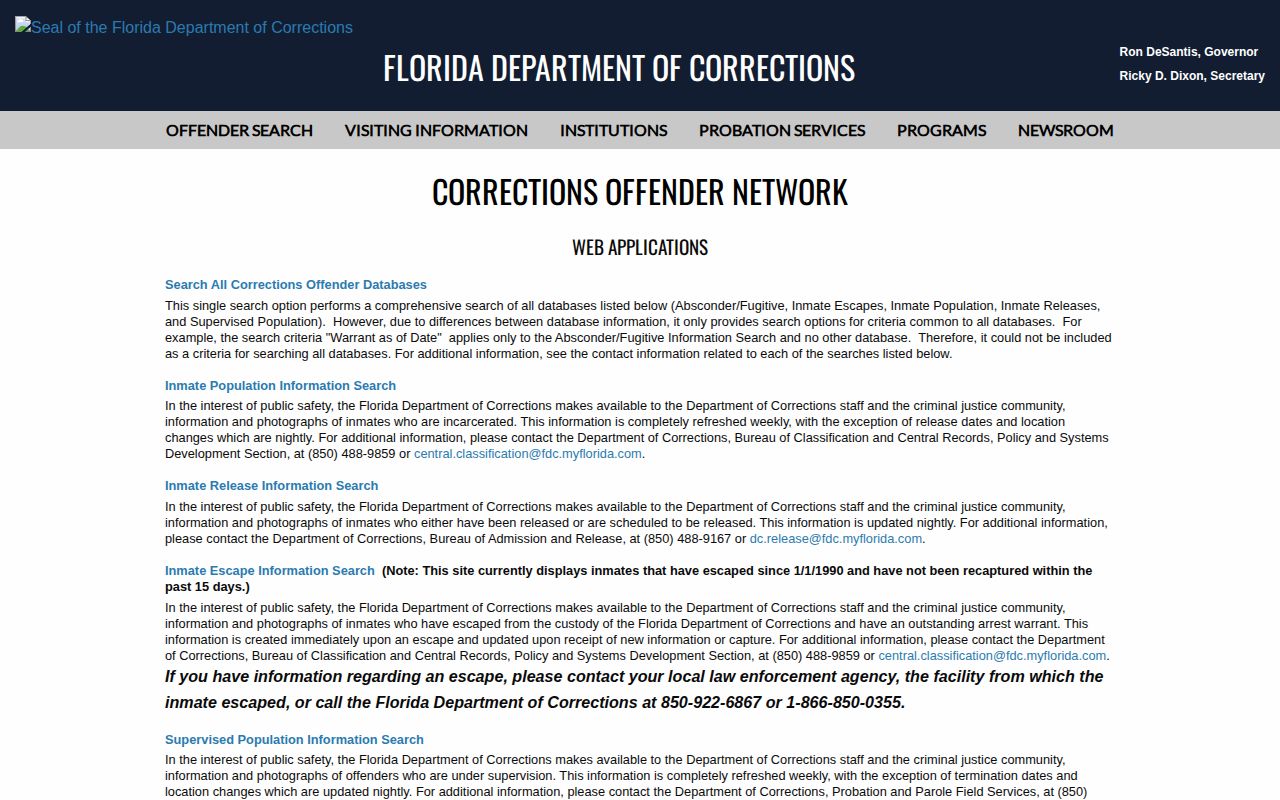
The separate databases prevent a current inmate, a released prisoner, and a supervised person from being treated as the same status.
Note: A match in the release database is incomplete until the detail shows a past release date and past date out of custody.
FDC Clay Release Record Fields
The public detail carries identity and custody blocks, aliases, sentence history, and incarceration history. A Clay case should be matched through the county and case number, not name alone. The state page may also show an FDC photograph and a stated residence. It does not expose a public field expressly labeled Release Type, Release Reason, or Discharged.
| FDC field | What it establishes |
|---|---|
| DC Number | The stable state corrections identifier used to separate similar names. |
| Release Date | The state release date, which must be past to support a completed event. |
| Date Out-Custody | The end of an incarceration-history segment. |
| County and case number | The link between the FDC sentence and the Clay court judgment. |
| Stated Residence Upon Release | The reported destination, not proof that supervision or all custody ended. |
| Supervision status | Whether a person out of prison remains under an FDC community term. |
The Clay County released-inmate search explains how to reconcile the state record with the earlier CCSO transfer and Clay court docket.
For repeated admissions, read each incarceration-history segment. Date In-Custody and Date Out-Custody belong to a specific period and should not be mixed with another sentence. Aliases and photographs help identify the person, while the Clay case number connects the correct sentence. If a record lists a residence or supervision office, treat it as agency-reported information at that point in time. It does not prove a present address or the end of all court duties.
FDC Release Dates Can Change
A current FDC inmate detail uses the exact label Current Release Date. Florida law uses tentative release date for a related calculation based on gain time granted or forfeited. FDC warns that its public date can move pending an award, forfeiture, or review. “TO BE SET” means review is pending and should not be estimated.
Florida Statutes section 944.275 authorizes defined forms of gain time and sets an 85-percent service floor for covered sentences. Awards are not automatic. Discipline, corrected sentence documents, jail credit, overlapping terms, detainers, and review can change the displayed date. A future date helps with planning but never proves the person left custody.
Confinement Status can also mislead when read alone. FDC treats it as an internal status, and a record may say “Not in Confinement” while still listing a facility and current incarceration. A completed state release requires the release-specific record and a past Date Out-Custody.
Note: A future Current Release Date is planning data, while a past Date Out-Custody documents a completed incarceration segment.
FDC Supervision After Clay Release
The FDC supervised-population search covers state probation and parole. Search by DC number or name, then verify the listed office, case details, photograph, and termination information. FDC says most supervision data refresh weekly, while termination dates and location changes update nightly.
Clay misdemeanor probation is different. Clay Clerk Probation Services handles that local court channel, while FDC handles felony supervision. A jail-only sentence does not become an FDC prison record merely because probation follows. An absconder entry means the person ceased making himself or herself available for supervision. It does not erase the earlier release from prison.
- Prison release
- The end of an FDC incarceration period.
- Community supervision
- A court- or Commission-authorized term served outside prison under conditions.
- Discharge
- The formal end of the relevant custody or supervision obligation.
Note: Check the FDC supervision record after prison release because an out-of-custody person may still have an active reporting term.
FDC Release Records and Contact
For more than the public detail, request the admission and release record, sentence computation, incarceration history, release authorization, and gain-time history through FDC public records. Provide the full name, DC number, date of birth where needed, Clay case number, exact record names, and a date range. Ask for electronic delivery and an estimate.
The public-record instructions below show the official request route and the types of details that help FDC locate a file.
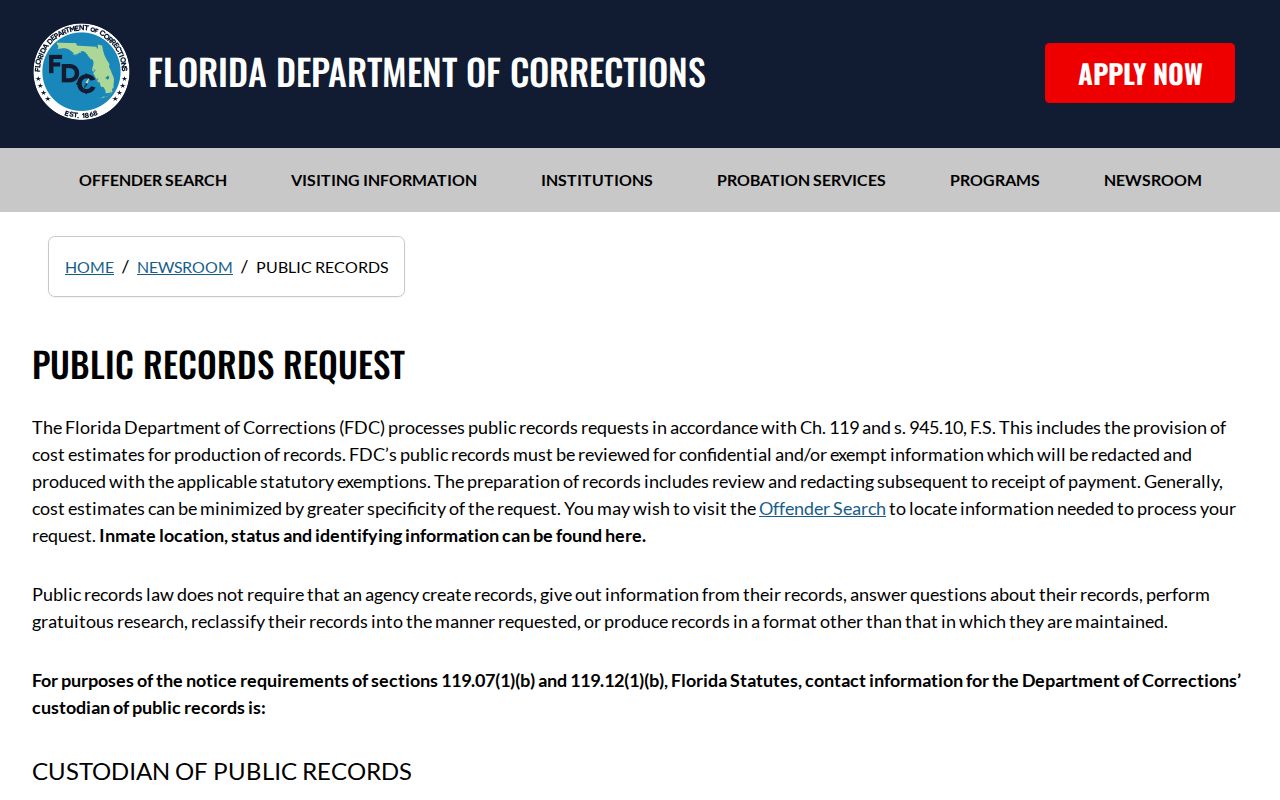
A focused request is the best way to obtain a release reason or calculation that the public offender detail does not display.
Florida Department of Corrections Public Records501 S. Calhoun Street
Tallahassee, FL 32399
Assistance: (850) 717-9774
Fax: (850) 488-4534
Date and status questions go to the Bureau of Admission and Release at (850) 488-9167 or dc.release@fdc.myflorida.com. Suspected data errors go to Classification and Central Records at (850) 488-9859 or central.classification@fdc.myflorida.com.
No FDC Prison in Clay
Current state and county directories do not identify an FDC prison physically located in Clay County. The system entry belongs in the Clay facility map because people can leave the county jail for state custody and later return to the community under a statewide release record. It should not be presented as a local prison address.
The older Clay jail handbook also notes that a person transferring to FDC must arrange for property that the state will not accept. That local transfer detail supports requesting the CCSO transfer sheet and property receipt. It does not change which agency owns the later prison release. CCSO documents departure from Clay; FDC documents the state incarceration and release.
Historical ICE material concerning the Clay jail does not turn FDC into a local facility or prove any current federal arrangement. Each custody system must be checked on its own terms.
Clay ICE History Is Not FDC
Historical ICE records show immigration detainees at the Green Cove Springs jail in 2003. Current ICE facility sources found in the research do not establish that jail as a present ICE detention site. This dated federal history is not evidence of an FDC prison in Clay County, and it says nothing about where FDC assigned a person sentenced in a Clay case.
The release sheet should control the branch. A transfer to FDC leads to the state offender record. A transfer to ICE leads to the federal detainee locator. A USMS entry leads to federal court and Marshals records. Keeping those routes separate prevents a historical contract reference from being used as current proof of custody.
Clay Sentences in FDC Records
The Clay Clerk docket remains important after FDC takes custody. It can show the judgment, offense, sentence, and court-awarded jail credit. FDC applies that material within its own sentence computation. If the public state detail appears to conflict with the court order, obtain the certified judgment and ask FDC to review the computation rather than changing the date by hand.
A court order may explain why a sentence changed, but only FDC can certify its prison release event. Conversely, FDC does not own the date when CCSO completed the earlier transfer. A complete chronology can require the Clay release event, the judgment and credit, the FDC admission history, and the later state release authorization.