
Clay Parole and Probation Compared
Parole and probation both allow a person to live in the community under rules, but they begin in different ways. Probation is imposed by a court. It may be part of a sentence after a Clay County case. Parole is granted by the Florida Commission on Offender Review, or FCOR, and lets an eligible state prisoner serve the balance of an older sentence in the community. Florida largely ended parole eligibility for crimes committed on or after October 1, 1983, apart from narrow legacy groups. Many people released from a Florida prison are therefore not parolees.
Florida Department of Corrections, or FDC, supervises state probationers and parolees. FCOR decides parole and runs other release programs. Clay Clerk Probation Services has a separate role for local misdemeanor cases. The court docket identifies what the judge ordered, while the FDC record identifies state supervision. Calling the Clay County Jail cannot settle either question.
| Record type | How it begins | Clay verification path |
|---|---|---|
| Probation | A court orders community supervision as part of the sentence. | Check the Clay criminal docket, then the FDC supervised-population record for felony supervision or Clay Clerk Probation Services for a misdemeanor. |
| Parole | FCOR authorizes an eligible state prisoner to serve part of the sentence in the community. | Check the FDC supervision record and obtain the final FCOR order when the decision itself matters. |
| Conditional release | Florida law requires post-prison supervision for a qualifying inmate, generally tied to gain time. | Read the FDC record and FCOR order; do not call it discretionary parole. |
- Discharge
- The formal end of custody or supervision, not merely release from a jail or prison building.
- Absconder
- A supervised person who has stopped making himself or herself available to the supervising agency.
- Revocation
- A formal action that can end community release after an alleged breach and return the person to custody.
Verify Clay Post-Release Supervision
The official FDC supervised-population search is the first check for state parole or felony probation. Search by the six-character DC number when it is known. A DC number is all digits or one letter followed by five digits. A name search uses prefix matching, so several people may appear. Match the photograph, date of birth, aliases, case data, and listed office before relying on a result.
The search is not a copy of every Clay County jail release. Someone can be out of the county jail with no state supervision at all. FDC says most supervised-population data refresh weekly, while termination dates and location changes update nightly. Those update cycles matter when a court has just changed the sentence or when supervision has just ended.
- Search the FDC supervised population by DC number or full name, with aliases enabled when needed.
- Open the matching record. Confirm identity, Clay County case information, supervision type, status, and office location.
- Compare the record with the Clay Clerk criminal docket. The docket supplies the sentence and later court orders.
- For a misdemeanor, contact Clay Clerk Probation Services. For state parole or felony supervision, use the office named by FDC.
- If the normal search fails but reporting may have stopped, check the separate FDC absconder record. Confirm any result with the agency.
The state supervised-population form shows the actual fields used for this Clay supervision check.
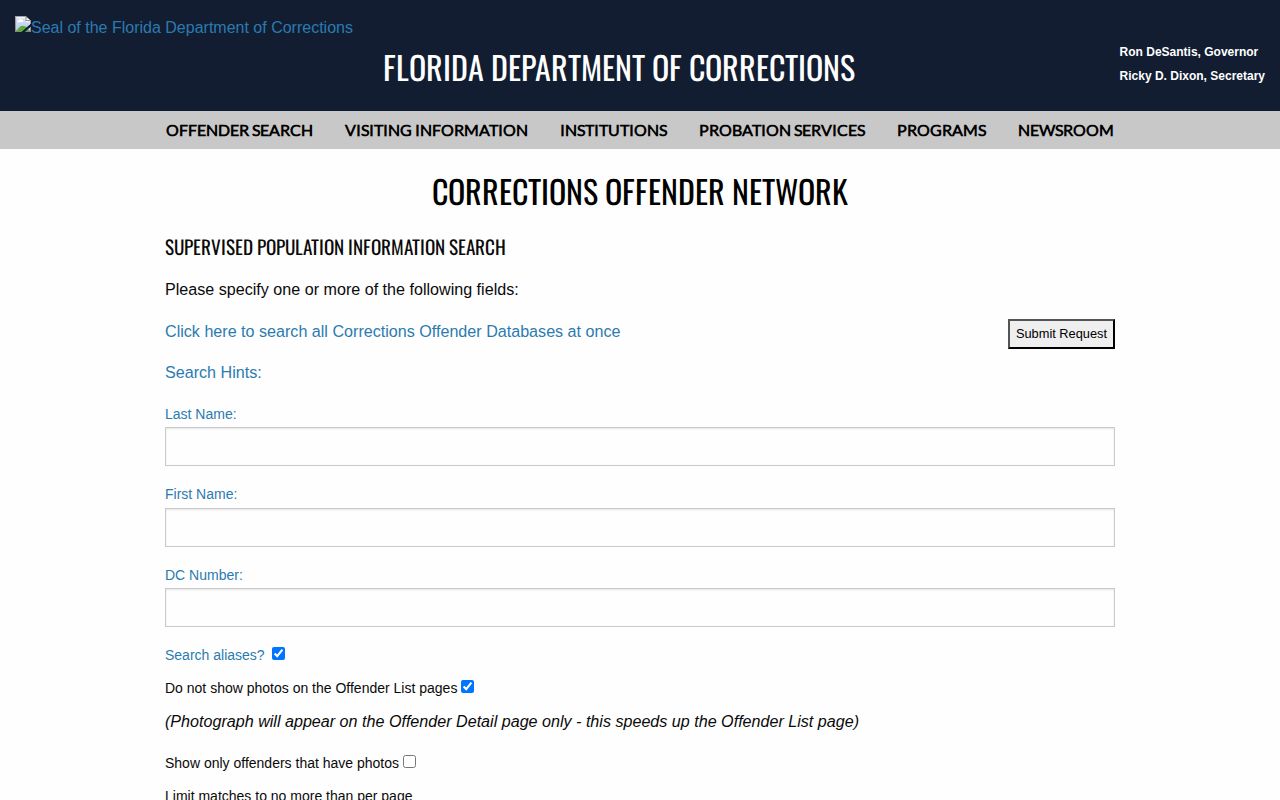
That form is for people under state supervision, not for every person whose Clay County jail card says released.
Note: A prison release date and the end date of parole or probation are separate events and should be read separately.
Clay Misdemeanor Probation Route
Clay County has a local channel that is easy to confuse with FDC. Clay Clerk Probation Services handles misdemeanor probation. Its page says the judge gives the defendant a counselor assignment and intake appointment in court after sentencing. Monthly meetings track both monetary and nonmonetary conditions and set the next appointment. A request to reschedule must be made within 24 hours by speaking directly with the counselor. Voicemail by itself is not approval.
The Clerk office redirects felony probation to FDC and juvenile probation to the Florida Department of Juvenile Justice. This division is a strong identity check. A misdemeanor docket should not be forced into the FDC felony path, and a felony state-supervision record should not be treated as a Clerk misdemeanor file.
Clay Clerk Probation ServicesClay County Courthouse, Room 2101
825 N. Orange Avenue
Green Cove Springs, FL 32043
Phone: (904) 278-3615
Felony probation referral: (904) 213-2930
The official Clay probation page illustrates the misdemeanor and felony split.
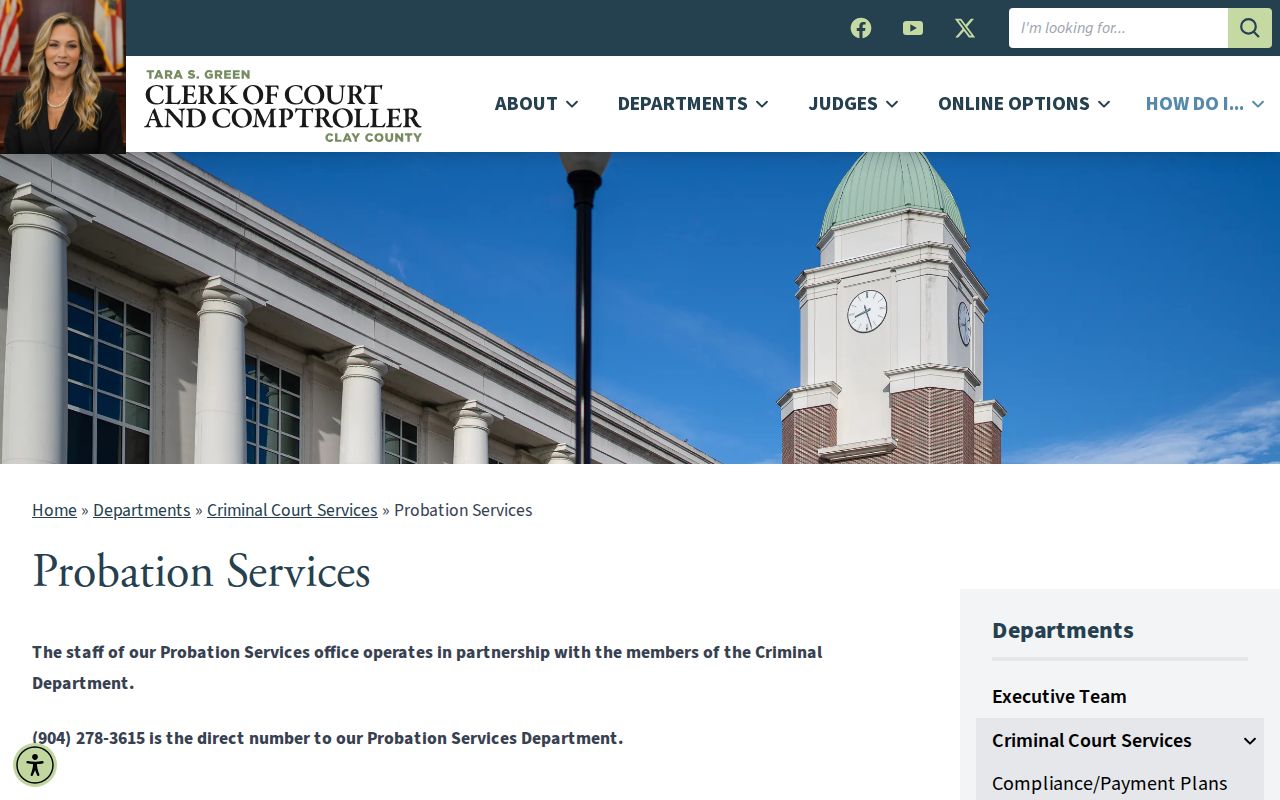
The office shown there serves the local court function and does not replace the statewide FDC record.
Clay Parole and Absconder Records
Supervision conditions come from the court order, the FCOR order, or the assigned officer's instructions. They can include reporting, treatment, payment, travel limits, or other case-specific duties. A public search should not be used to guess the full set of rules. Obtain the signed order and ask the listed office when exact terms matter.
FDC maintains a distinct Absconder/Fugitive search. FDC uses that label for people who ceased making themselves available for supervision. An absconder result does not undo the historical prison release. It signals a later enforcement issue. The Absconder Unit accepts whereabouts information at (850) 717-3475 on weekdays from 8:00 a.m. to 5:00 p.m. Immediate safety or enforcement concerns belong with local law enforcement. CCSO does not publish active warrants online and will not discuss them by phone.
Clay Parole Hearings and Outcomes
FCOR publishes a monthly hearing calendar and detailed agendas. In-person parole hearings normally occur on Wednesdays, with Thursday follow-up sessions by video or teleconference. An agenda can identify a person, DC number, case, county, and hearing category. A Clay County entry proves that a matter was set for review. It does not prove release was approved.
No official name-searchable FCOR results database was found in the research sweep. To confirm what happened, compare the FDC offender record and request the vote sheet or final signed Commission order through the FCOR public-records route. A grant may set a later effective date subject to a plan and conditions. A denial keeps custody in place under the sentence. Deferral means the matter returns later. Rescission can withdraw an earlier action, while revocation concerns an alleged breach after community release.
FCOR Region II, Jacksonville2050 Art Museum Drive, Suite 108
Jacksonville, FL 32207
Phone: (904) 348-2610
Fax: (904) 348-2634
Note: Region II serves Clay County, but the FDC detail record controls which field office supervises a specific person.
Clay Release Planning Before Supervision
The Clay County jail handbook describes an internal release-preparation route. A person may ask the Programs Coordinator, chaplain, or medical staff for help while still housed at the jail. A person who expects transfer to FDC may ask a detention deputy about clothing and property limits, then discuss the move with chaplain or classification staff. These are navigation points inside the facility. They are not a promise that a certain program, placement, or service will be available after release.
That distinction matters for supervision. The first FDC or Clerk reporting instruction still comes from the sentencing or supervising authority. Jail staff can help a person prepare, but they do not replace the officer assignment or change the court and Commission orders. If a release route is unclear, compare the jail event, court disposition, and FDC status before deciding where the person must report.
Property After Clay County Release
Clay's handbook says county-issued property is reconciled before release and personal property is returned. If an item is missing, the person should not sign the receipt and should ask for a supervisor. A balance left in the person's account may be mailed as a check or collected within five business days. FDC transferees must arrange for property that the state system will not accept, because such items cannot simply remain at the jail.
The same record-owner rule applies to a bad release or supervision entry. Contact CCSO with the booking number for a county record, FDC with the DC number for a state record, or the Clerk with the case number for a court order. Include the supporting order or document. A general web source cannot correct an agency's official file. Broader Clay release-record steps are available on the Clay County released inmates home page.
Note: A signed property receipt and a supervision discharge order prove different facts and should remain separate in any record request.
Clay Supervision Discharge Records
Supervision ends through a formal termination or discharge, not because the person simply stops appearing at an office. The FDC detail and Clay court docket may show the key dates, but each answers a different part of the question. The docket can contain a judge's order. FDC keeps the state supervision status and termination information. For parole, the Commission order may also be needed to show what authority ended or changed the term.
If the public record has not caught up, request the termination or discharge document from the agency that issued it. Provide the name, DC number, Clay case number, and the date range. A person who has completed probation should not be described as an absconder merely because an old page remains online, and a blank search should not be called proof of completion. The signed order and updated agency status provide the soundest answer.