
Understanding Clay County Releases
“Released” means that a specific Clay County booking ended. It does not always mean the person walked into the community. The Clay County Jail, also called the Clay County Detention Facility, may release someone after bond, recognizance, a purge payment, a fine, court disposition, or time served. It may also transfer the person to another jail, the Florida Department of Corrections, federal custody, or immigration custody. That distinction controls which record should be checked next.
A person usually drops from a current-custody roster after the jail closes the booking. The absence of a name is weak proof by itself. A dated release event is stronger, while a release reason and receiving-agency field show whether confinement truly ended. Clay County released inmates may also have probation, parole, registration duties, or another pending case after physical release. Match the booking number and court case before drawing a conclusion from a name search.
- Bond
- Release while the criminal case continues, secured by cash or a surety.
- Recognizance
- Release without money posted, based on a promise to appear.
- Time served
- The ordered jail term has ended, though other duties may remain.
- Discharge
- The end of a custody term or supervision term, depending on the record.
- Detainer
- A request or hold from another agency that may lead to a transfer.
Clay County Release Paths
Clay booking staff must finish more than a door-opening task. The jail handbook says staff check for wants from other jurisdictions, account for county property, complete release paperwork, return personal property, and obtain a receipt. The resulting event log and transfer paperwork help distinguish a community release from a handoff. Court orders establish legal authority, but the jail record shows when staff completed the physical exit.
| Release path | What it means | Best next record |
|---|---|---|
| Cash or surety bond | The person leaves while the case remains open. | CCSO release event and Clay court docket |
| Recognizance or purge | A court-authorized release occurs without a surety bond, or after the stated purge is paid. | Court order plus jail exit time |
| Fine paid or charges disposed | The legal event may end the basis for that booking. | Clay Clerk disposition and CCSO event |
| Time served or end of sentence | The county custodial term ends. | Jail release record and any supervision record |
| Transfer | Clay custody ends but another agency takes custody. | Receiving agency locator or records office |
Does “bonded out” mean the charge was dismissed? No. Bond changes custody status while the case proceeds. The Clay criminal docket remains the source for later pleas, dismissal, judgment, or sentence.
Bonding Out in Clay County
The Clay inmate handbook separates cash bond, surety bond, own-recognizance release, and a purge payment. Each has a different paper trail. A surety agent must deliver the required papers before booking staff can start release processing. Jail staff cannot recommend one bonding agency over another. A cash or surety payment also does not settle the charge.
For a Clay County release record after bond, request the bond type, amount, status, authorization received time, and actual exit time. Then check the court docket for conditions and the next appearance. A hold from another jurisdiction may prevent a community exit even when the Clay bond is satisfied. This is why the release reason and hold disposition matter more than the bond amount alone.
Clay County Release Context
Florida’s July 2025 county detention report gives useful local context, but it is not a release count. The report listed an average daily population of 401 at Clay County Jail. Of that group, 261 people were felony or misdemeanor pretrial detainees, a 65.1 percent pretrial share. These figures describe one month’s average custody stock. They do not state annual bookings, exits, or length of stay.
The snapshot helps explain why bond, recognizance, and court-order exits are major local paths. It cannot support a claim about how many Clay County inmates were released that month.
Note: Population figures describe who was held on an average day, not how many Clay County releases occurred.
Clay County Release Record Fields
The public Police-to-Citizen card is a discovery record. Its current settings may show a calendar date labeled “Released” or “Expected release,” but they suppress the release time and reason. A requested inmate file is far more useful when the exact event matters. Ask for fields that tie identity, booking, legal authority, and destination into one chain.
| Field | What it shows |
|---|---|
| Full name, date of birth, booking number | Which person and which Clay admission the record concerns |
| Booking date, arrest agency, charges | The start and legal basis of the custody episode |
| Bond type, amount, status, court date | Whether a bond path applied and what case follows |
| Holds and detainers | Whether another agency could take custody |
| Authorization received | When booking obtained the court or payment paperwork |
| Physical release date and time | When Clay custody actually ended |
| Method, reason, receiving agency | Whether the person entered the community or another system |
| Property and funds receipt | What was returned or remained for later pickup |
Florida’s GS2 records schedule sets a minimum of one anniversary year after release for booking records, commitment and release lists, and inmate incarceration records. Jail docket books are permanent. Those are retention floors for agency records, not promises that a public web card remains visible for the same period.
Request Clay County Release Records
The CCSO public-record request page permits an anonymous request. A requester does not have to submit it in writing or state a reason. Use the online portal, call the Public Records Section at (904) 529-6090, mail the request, or visit the sheriff’s headquarters. A precise request can reduce delay and unrelated material.
- Identify the person, date of birth if known, booking period, and booking number.
- Ask for the release authorization, actual physical release date and time, method, holds, and each hold’s disposition.
- Request the receiving agency and destination if the event was a transfer. Include property and funds receipts when those facts matter.
- Choose electronic records and ask for an estimate before authorizing costly work.
- Ask CCSO to cite the basis for each redaction and release all nonexempt portions.
901 N. Orange Avenue
Green Cove Springs, FL 32043
(904) 529-6090
The posted 2021 fee schedule lists booking photos and ordinary report pages at $0.15 per page, certification at $1 per certified page, and a special-service charge when preparation exceeds 30 minutes. CCSO now links a January 2026 fee document whose prices were not machine-readable during research. Ask for a current estimate before relying on the older schedule.
Note: Confirm the current CCSO fee estimate before approving a request that may require extensive staff review or redaction.
Clay County Release Record Law
Florida Constitution article I, section 24 and Florida Statutes Chapter 119 create broad access to government records, subject to specific exemptions. Section 119.07 addresses inspection, copies, and authorized fees. Release files can still contain redactions for juvenile material, protected victim details, medical facts, security data, sealed cases, or other exempt content.
Sealing and expungement can restrict public access without changing the fact that custody once ended. A blank search after a court order does not prove no booking existed. Clay County petition forms and an FDLE certificate may be part of the process under sections 943.0585 and 943.059, but only a court order grants relief. The public records custodian, not an unofficial data source, should correct an official release entry.
Note: Ask for nonexempt fields separately when a release file contains protected material that the custodian must redact.
When Clay County Releases Occur
Clay County publishes an unusually specific end-of-sentence rhythm. The jail FAQ says eligible end-of-sentence inmates may begin leaving after midnight when they have a ride. Otherwise, exits begin at the 0600 shift change. This gives families a planning point, not an appointment. Unusual conditions can extend the process.
Court-ordered and bond releases work differently. Booking cannot act until the authorization reaches that room, and court papers may arrive in batches rather than in hearing order. Surety paperwork must also reach staff before processing starts. A judge’s oral ruling or a bond payment time is therefore not the same as the physical exit time shown in the Clay County release event.
Getting Home After Clay Release
Clay Community Transportation serves Green Cove Springs. Its Blue Line includes the nearby Clay County Courthouse, and flex deviations of up to three-quarters of a mile may be available when the schedule permits. The published reservation number is (904) 284-5977. County information describes weekday service, not weekend or holiday service.
The courthouse stop is not a jail-release shuttle. The jail and courthouse are close, but a person leaving at night, on a weekend, or on a holiday should not assume transit will be waiting. The current Clay transportation details should be checked before travel.
The route page helps plan the trip, while a direct pickup remains the safer plan when the release time may shift.
Note: Published weekday transit service does not ensure a ride at the hour Clay booking completes a release.
Clay County Release Preparation
The jail handbook identifies internal points of contact before a Clay County release. A person may request release-preparation help through the Programs Coordinator, chaplain, or medical staff. Someone transferring to FDC may also ask a detention deputy about clothing and property rules, then discuss expectations with chaplain or classification staff.
These are internal navigation options, not a guarantee of aid after release. They are most useful before the booking closes. A family seeking to confirm what was arranged should ask the person directly and verify any agency-specific reporting duty through the office that imposed it.
Property After Clay County Release
Before release, Clay staff reconcile county-issued items and return personal property. The handbook tells the person not to sign the receipt if something is missing and to ask for a supervisor. A remaining inmate-account check may be mailed or held for collection within five business days. The signed receipt and account-disbursement record can resolve disputes better than a roster entry.
If a public release entry is wrong, contact the agency that owns it. Provide the Clay booking number or FDC DC number, along with the court order or other source that supports the correction. An unofficial publisher cannot amend the sheriff’s event log, the Clerk docket, or the FDC record.
Match Clay Release Court Records
The Clay courthouse at 825 N. Orange Avenue and sheriff complex at 901 N. Orange Avenue sit close together, but they keep different evidence. The court docket can show a bond order, recognizance release, disposition, sentence, jail credit, probation, violation, or completion. Booking staff’s event log shows when the person physically left Clay custody.
Use the Clay Clerk court search by name and case number, then match the booking period. Court authority and jail execution should agree, but neither office certifies the other office’s event. For precise proof, obtain both records and reconcile the order date with the actual exit time.
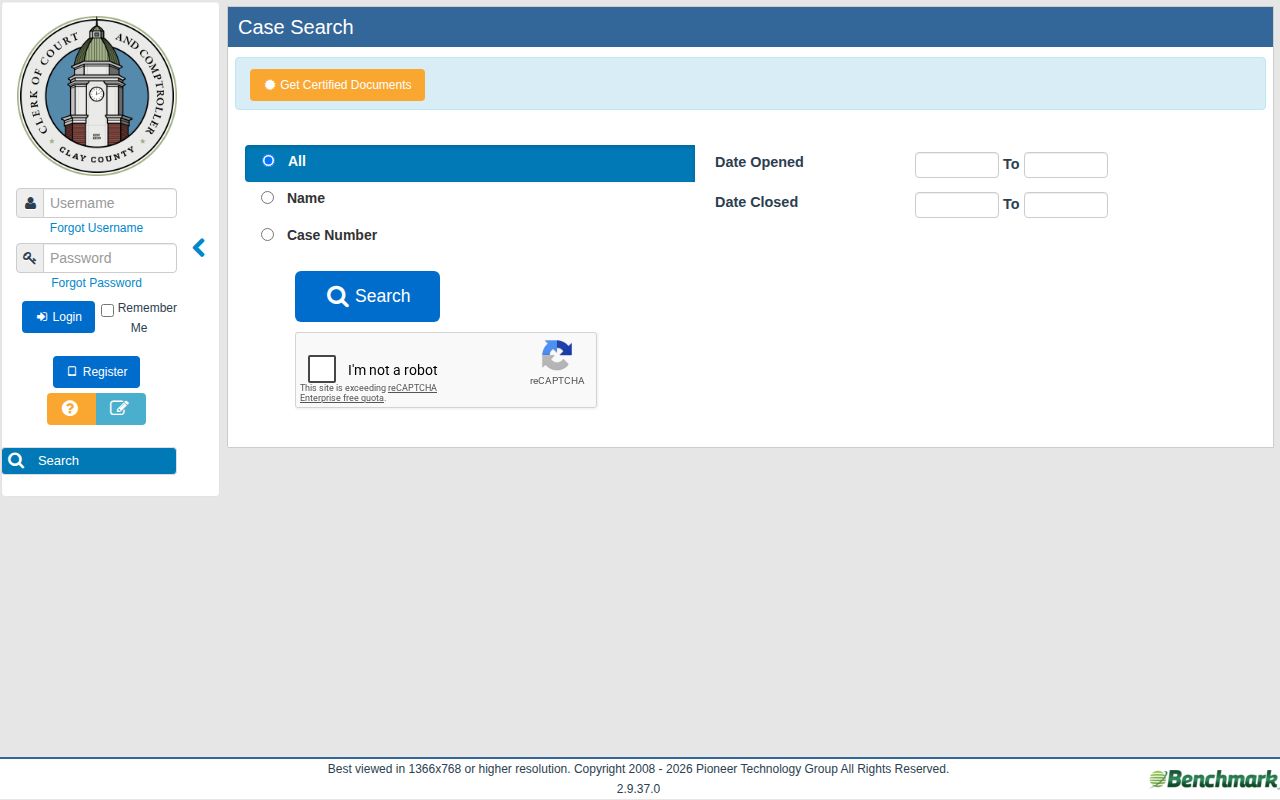
The court search survives longer than many live jail cards and is especially useful when the public catalog no longer returns the booking.
Note: A court order supplies legal authority, while the Clay jail event log supplies the actual exit time.
Find Clay County Released Inmates
Begin with the agency that last held the person. Clay County jail-only cases start at the sheriff catalog and Clerk docket. State-prison cases start with FDC. Federal and immigration transfers require separate locators. This sequence avoids treating the end of one agency’s booking as proof that all custody ended.
- Search the CCSO catalog by exact first and last name. Add a middle name, age, arrest date, charge, race, or sex to separate similar names.
- Save the booking date, agency, charge, bond, court date, booking number, and any released or expected-release date shown.
- Match the Clay criminal case. Read the bond, release order, disposition, sentence, and probation entries.
- Ask CCSO for the physical exit time, release reason, holds, and receiving agency when the card is absent or incomplete.
- Follow a named transfer into FDC, BOP, ICE, another jail, or the relevant supervision system.
- Use VINELink for ongoing alerts, then verify an alert with the agency record.
The CCSO catalog has no dedicated countywide recent-release module. It can help check one known person, but an exact 24-hour or 72-hour list requires a focused records request. Do not substitute a recent-arrest bulletin. An arrest feed records entry into the process, not release from it.
Clay County Release Catalog
The official CCSO inmate catalog accepts last, first, and middle name plus age, charge, arrest date, race, and sex. Result cards can include name, physical traits, arrest date, court date, primary charge, bond, detailed charges, booking agency, image, and a release or expected-release date. Live settings suppress release time, release reason, holding facility, arresting agency, and date of birth.
A card with a past date labeled “Released” is useful evidence, but it cannot distinguish release to the community from a transfer. The agency also does not promise an update interval or a public-display retention period. Save the booking details and obtain the underlying release record when the reason or exact time matters.
The screenshot comes from the official CCSO catalog and shows the public search controls used for a named-person check.
Those search controls support a named-person check, not a complete Clay County recent-release feed.
FDC Clay Release Search
Use the FDC Inmate Release Information Search for a Clay County person who entered state prison. It is not a history of every county-jail booking. The form accepts last name, first name, and DC number, with alias and photo choices. A DC number has six characters, either all digits or one letter followed by five digits.
| Search field | Use | Check after opening result |
|---|---|---|
| Last and first name | Begins-with name matching | Birth date, race, sex, aliases, photo |
| DC number | Best direct identity key | County, case, and sentence history |
| Aliases | Finds another recorded name | Confirm the main identity block |
| Release search result | Includes released and scheduled cases | Both Release Date and Date Out-Custody must be past |
FDC updates this release search nightly. A hit can represent a future scheduled release, so open the detail record. Confirm that Release Date and Date Out-Custody are both past. Then check whether community supervision remains active. Prison release and full sentence discharge are separate events.
Note: A future FDC release date is a schedule, not proof that the person has already left state custody.
Clay Release Supervision Search
Release from custody does not always end supervision. FDC operates Florida felony probation and community supervision, while the Florida Commission on Offender Review handles parole for eligible cases. Search FDC’s supervised-population record and match the DC number, county, case, and listed office. An absconder entry means the person is alleged to have stopped reporting, not that the past release did not occur.
Clay misdemeanor probation follows a local path through Clerk Probation Services. The court assigns the counselor and intake appointment after sentencing. Felony probation goes to FDC, and juvenile probation goes to the Department of Juvenile Justice. The Clay County parole and probation resource separates those offices and explains how a later discharge ends supervision.
Clay Release Alerts and Locators
Florida VINELink can provide custody status and notifications for a specific participating agency record. Search the exact person, verify the booking, and register the offered phone or email channel. An alert reports a custody change from the source feed. It is not a certified Clay County release record and should be checked against the holding agency.
For a Florida state prisoner, use FDC release and supervised-population records. For a federal sentenced prisoner, the BOP Inmate Locator accepts federal identifiers or name filters. A past release date with no facility, or a location of “RELEASED,” means the person is no longer in BOP custody. It does not rule out supervision or custody elsewhere. A federal pretrial defendant held for the U.S. Marshals may never appear as a sentenced BOP prisoner.
The FDLE sexual offender and predator registry is narrower. It can confirm the public registration status of someone who is legally required to register, but it is not a broad list of Clay County released inmates. No result for an ordinary released person is expected.
Clay Release Transfers to ICE
An ICE detainer may lead ICE to assume custody when Clay releases a person from its booking. In that event, “released from CCSO” is accurate, but “released to the community” is not. Search the ICE Online Detainee Locator System by nine-digit A-number and country of birth, or by exact name, country of birth, and birth date.
Current ICE guidance says ODLS covers adults in ICE custody and people released from ICE custody within the prior 60 days. It is not a permanent archive. Historical ICE material documents immigration detainees at the Green Cove Springs jail in 2003, but current facility directories do not establish the jail as a present ICE detention site. That older record must not be used to claim a current detention contract.
Note: A Clay release to ICE ends county custody but begins or continues a separate federal custody stage.
Where Clay Release Records Appear
The same person may move through more than one system. Use current-custody tools for someone still held and durable release records for someone whose custody event ended. The agency named in the transfer field becomes the next source.
| Situation | First place to look | What confirms release |
|---|---|---|
| Still in Clay County Jail | CCSO inmate catalog | Current booking and status, not a release |
| Released from Clay jail | CCSO release file and Clay Clerk docket | Physical exit time, reason, and any destination |
| Transferred to state prison | FDC offender search | Past Release Date and Date Out-Custody |
| Released federal prisoner | BOP locator | Past date and RELEASED or no facility |
| Transferred to ICE | ICE ODLS | ICE status following the Clay handoff |
| Under supervision | FDC supervised search or court docket | Active probation, parole, or completion entry |
Can a person be released and still supervised? Yes. Release from a jail or prison ends that custody stage. Probation or parole may continue until a separate discharge or completion event.
Clay County Release Systems
Clay County Jail is the local adult detention facility and the source for county booking-release events. FDC covers state prisons and state community supervision, with assignments anywhere in Florida. BOP covers sentenced federal prisoners. ICE ODLS covers current and some recently released immigration detainees. The Clay Clerk docket records court authority but does not operate a jail.
- Clay County Jail: community release, court-based release, or transfer to another agency.
- Florida Department of Corrections: state prison release dates and state supervision.
- Federal Bureau of Prisons: federal custody and release for covered sentenced prisoners.
- ICE Detention Network: immigration custody after a detainer or federal handoff.
- Clay County Criminal Court Records: bond, orders, disposition, sentence, and probation entries.
Read each result as one link in the custody chain. The Clay release reason and receiving agency determine whether the search should stop or continue.